Why Your Joints Ache in the Morning in Perimenopause and What Helps
Quick Answer: Joint aches and morning stiffness are extremely common in perimenopause and are increasingly recognised clinically — sometimes grouped under the term musculoskeletal syndrome of menopause. The main driver is falling and fluctuating oestrogen, which has anti-inflammatory effects and supports cartilage, tendon and synovial tissue. It typically presents as stiffness that is worst on waking and eases within 20 to 30 minutes of moving, often in hands, knees, shoulders and neck. It is real, it is not automatically arthritis, and it responds well to movement, strength work and — for some people — treatment worth discussing with a doctor.
Most people assume it is age, or a mattress, or that they slept badly.
It is worth knowing what it actually is, because several of the things that help are things you would not otherwise prioritise.

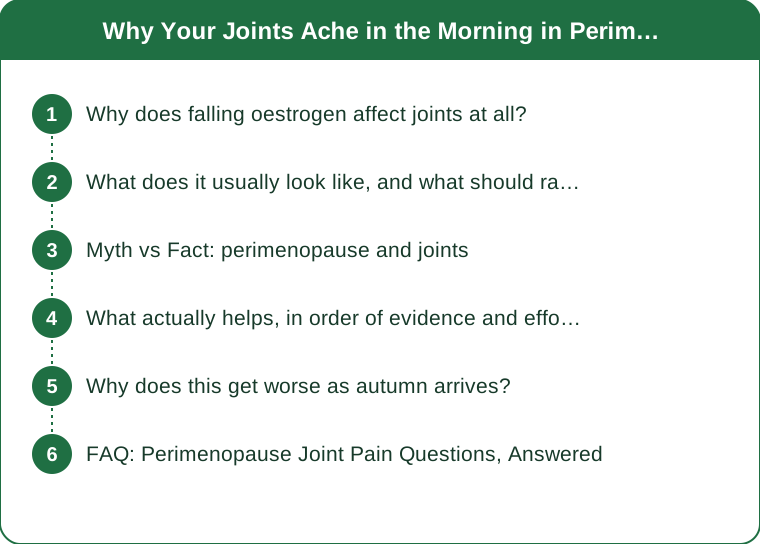
Why does falling oestrogen affect joints at all?
Because oestrogen receptors are present throughout musculoskeletal tissue, and its role there is broader than most people realise.
Oestrogen has anti-inflammatory effects. As levels fall, inflammatory signalling increases, and joint tissue is sensitive to that shift. This is thought to be a significant part of why symptoms often appear across several joints at once rather than in one.
It supports cartilage maintenance. Oestrogen receptors are found in cartilage, and declining levels are associated with changes in cartilage turnover.
It affects tendon and ligament properties. Collagen structure and hydration are influenced by oestrogen, and tendon problems — particularly at the shoulder, hip and elbow — become notably more common in this life stage.
It influences fluid balance in tissues, including synovial fluid, which is what allows joints to move smoothly. Reduced lubrication contributes directly to the stiffness people describe.
And it affects pain perception centrally, so the same signal may be experienced as more intense.
The reason mornings are worst:
During several hours of stillness, synovial fluid is not being circulated, inflammatory mediators accumulate locally, and tissues sit in one position. Movement is what restores fluid distribution, which is why the stiffness reliably eases within twenty to thirty minutes of getting up and rarely returns until the next period of inactivity.
Is this the same as arthritis?
Not necessarily, and the distinction matters. Perimenopausal stiffness typically eases within 30 minutes of movement. Inflammatory arthritis characteristically produces morning stiffness lasting longer than an hour, often with joint swelling, warmth and symmetrical small-joint involvement. Any of that is a reason to see a doctor rather than to assume hormones.
What does it usually look like, and what should raise a flag?
The typical presentation, from what people commonly report:
Hands and fingers, often the first and most noticeable. Stiff, sometimes slightly swollen-feeling on waking, difficult to make a full fist for the first few minutes.
Knees, particularly on the first few stairs of the day, and after sitting for a long stretch.
Shoulders and neck, frequently with a sense of restriction rather than sharp pain. Frozen shoulder becomes considerably more common in this age range, which is thought to have a hormonal component.
Hips and lower back, often described as an ache rather than a stiffness.
Feet, especially the first steps out of bed — though this specific symptom also strongly suggests plantar fasciitis, which is worth distinguishing.
The pattern, which is the most recognisable feature: worst on waking, eases with movement, returns after any long period of sitting, and often varies week to week in a way that tracks hormonal fluctuation rather than activity.
What should prompt a medical appointment rather than self-management:
- Morning stiffness lasting more than an hour.
- Visible swelling, redness or warmth in a joint.
- Symptoms in one joint only, particularly with pain at rest or at night.
- Progressive worsening rather than fluctuation.
- Any accompanying fever, weight loss or profound fatigue.
- Symptoms that do not ease with movement at all.
These can indicate inflammatory arthritis or other conditions that benefit substantially from early diagnosis. Perimenopause being a plausible explanation does not make it the only one, and it is common for people in this age group to have their symptoms attributed to hormones without investigation.
This is general information, not medical advice. See a doctor for persistent or worsening joint symptoms.
Myth vs Fact: perimenopause and joints
Myth: Joint pain is not a menopause symptom. Fact: It is one of the most commonly reported and one of the least discussed. Surveys of people in this life stage consistently find joint and muscle aches among the top symptom categories.
Myth: It means arthritis is starting. Fact: It may be unrelated to arthritis entirely. The pattern of short-lived morning stiffness that eases with movement is characteristic of this hormonal picture rather than of inflammatory joint disease.
Myth: Rest is the right response to aching joints. Fact: Movement is. Stillness is what produces the symptom, and inactivity worsens it in both the short and long term. This is one of the clearest cases where the instinctive response is the wrong one.
Myth: Strength training will damage aching joints. Fact: Progressive resistance training is one of the better-supported interventions for musculoskeletal symptoms in this stage, and it also addresses bone density, which becomes a serious consideration as oestrogen falls.
Myth: It will pass on its own after menopause. Fact: For some people symptoms settle after the transition; for others they persist. Waiting it out is a strategy with an unknown timeline, and the things that help are worth doing regardless.
Myth: Supplements are the main answer. Fact: Evidence for most joint supplements is mixed at best. Vitamin D and calcium matter for bone health specifically, and are worth discussing with a doctor. Movement and strength have far better support.
Myth: HRT is only for hot flushes. Fact: Many people report improvement in joint symptoms on hormone therapy, and it is a legitimate topic to raise. Whether it is appropriate is an individual medical decision with benefits and risks to weigh, and that conversation belongs with a doctor.

What actually helps, in order of evidence and effort?
- Move within the first few minutes of waking. Not a workout — a few minutes of gentle range-of-motion work before you do anything else. Open and close the hands, roll the shoulders and ankles, a few gentle squats or sit-to-stands. This directly addresses the mechanism, and it makes the biggest difference for the smallest effort.
- Break up sitting. Every 30 to 45 minutes, stand and move for a minute or two. Long stillness is what recreates the stiffness during the day.
- Strength train two to three times a week. Progressive resistance work supports tendons, maintains muscle mass that protects joints, and is one of the few interventions that also addresses bone density — which is falling fastest during this exact window.
- Keep up aerobic activity. Regular moderate exercise reduces inflammatory markers and improves symptoms in most musculoskeletal conditions.
- Protect sleep. Poor sleep amplifies pain perception measurably, and perimenopause disrupts sleep for many people, which makes this a compounding loop.
- Address weight loading gradually if relevant, but do it through activity and nutrition rather than restriction, since low energy availability worsens bone and muscle outcomes.
- Check vitamin D, particularly heading into autumn and winter. Deficiency is common and it affects bone and muscle function.
- Discuss it with your doctor, including whether hormone therapy is appropriate for you, and ask for investigation if any red-flag features are present.
And one practical note about the morning routine: heat helps more than cold for this specific pattern. A warm shower before the movement routine, rather than after, makes the first few minutes considerably easier.
How long before movement changes make a difference?
The morning routine often helps on the first day. Strength training effects on aching build over six to twelve weeks. Both are worth giving a proper trial.
Why does this get worse as autumn arrives?
Several reasons, and they stack — which is why so many people find their symptoms noticeably worse from about October.
Cold reduces tissue extensibility. Muscles and tendons are genuinely stiffer at lower temperatures, and cold joints take longer to reach comfortable range. The morning routine that took five minutes in August takes ten in November.
Vitamin D production stops. At higher latitudes, the sun is too low from around October to March for the skin to synthesise vitamin D at all. Levels fall through winter, and vitamin D deficiency is associated with musculoskeletal pain and affects bone health directly. This is a genuinely important one during perimenopause, when bone density is already under pressure, and it is worth raising with your doctor now rather than in February.
Activity drops. Darker mornings and colder evenings reduce incidental movement — fewer walks, less time outdoors, more sitting. Since stillness is the mechanism, this directly worsens symptoms.
Sleep gets more disrupted for many people as light patterns change, and poor sleep raises pain sensitivity.
And there is a well-known association between cold, damp weather and reported joint pain, which is widely experienced even though the mechanism is not fully established.
What to do over the next several weeks:
- Lengthen the morning routine as temperatures drop, and add warmth before it.
- Ask about vitamin D at your next appointment, before winter rather than after.
- Move strength training indoors deliberately rather than letting it lapse when outdoor activity stops. This is the season when consistency is lost.
- Keep hands warm. Hand and finger stiffness responds noticeably to warmth, and gloves earlier in the season than you think you need them are worth it.
- Protect the morning light habit, which helps sleep, which helps pain.
This is general information, not medical advice. Discuss symptoms, vitamin D and hormone therapy with your doctor.
FAQ: Perimenopause Joint Pain Questions, Answered
Is this a sign menopause is close?
Not reliably. Joint symptoms can appear early in perimenopause, sometimes years before periods change substantially, which is part of why they get attributed elsewhere.
Does exercise make it worse?
Appropriate exercise almost always improves it. New or sharply increased loading can cause tendon irritation, so progress gradually — but rest is not the answer.
Should I take collagen?
Evidence is limited and mixed. It is unlikely to be harmful; it is not a substitute for loading the tissue, which is what actually drives tendon adaptation.
Why are my hands worst?
Small joints with a lot of surrounding soft tissue, used constantly and then held still all night. They are the classic presentation.
Can HRT help joint pain?
Many people report improvement, and it is a reasonable thing to raise with a doctor. Whether it is right for you depends on your individual medical picture.
Is it worth seeing a physiotherapist?
Yes, particularly for a single problematic joint like a shoulder, where early treatment substantially changes the trajectory.
TL;DR:
- Joint aches and morning stiffness are common in perimenopause and driven largely by falling oestrogen, which is anti-inflammatory and supports cartilage, tendon and synovial tissue.
- The signature pattern is worst on waking, easing within 20 to 30 minutes of movement.
- Stiffness lasting over an hour, swelling, warmth, or a single affected joint are reasons to see a doctor rather than assume hormones.
- Movement is the treatment, not rest. A few minutes of range-of-motion work before anything else in the morning.
- Strength training two to three times a week helps symptoms and addresses bone density at the same time.
- Autumn stacks the risks — cold tissue, vitamin D falling to zero production, and reduced activity. Ask about vitamin D now.
This is general information, not medical advice.
It is not your mattress and it is not simply age. It has a mechanism, and most of what helps is available to you today.
Keep Reading
This article is for general informational purposes only and is not medical advice. Always consult a qualified health professional for guidance specific to you.