Why Perimenopause Changes How Long a Warm-Up Needs to Be
Quick Answer: Falling oestrogen affects connective tissue hydration and elasticity, so tendons and fascia take longer to reach their working state. Blood flow redistribution to muscle also takes longer. In practice most people in perimenopause need a warm-up around twice as long as before — roughly 12 to 15 minutes rather than 5 to 8 — with the extra time spent on progressive loading rather than stretching.
You have warmed up the same way for two decades. Five minutes on the bike, a couple of mobility drills, straight into the first set.
Now the first set feels heavy in a way it did not use to, your knees complain for the first ten minutes of a run, and the session only starts feeling normal somewhere in the second half.
Your training has not changed and your fitness has not fallen off a cliff. What has changed is how long your tissue takes to get ready.

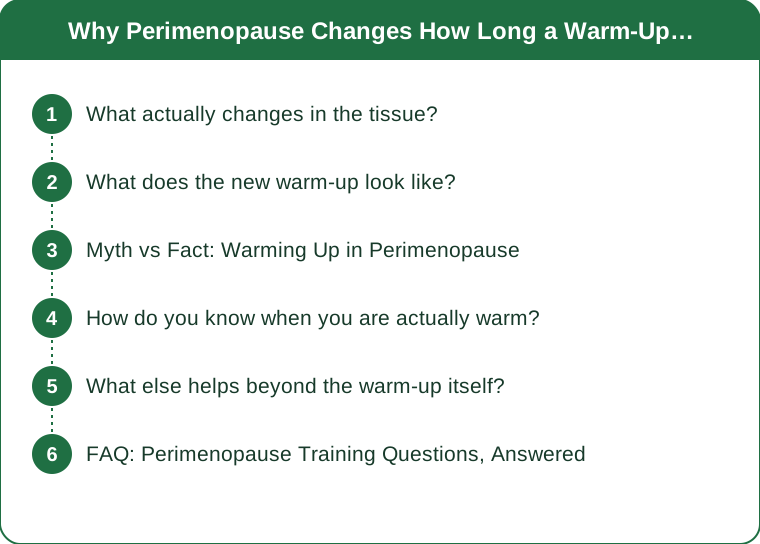
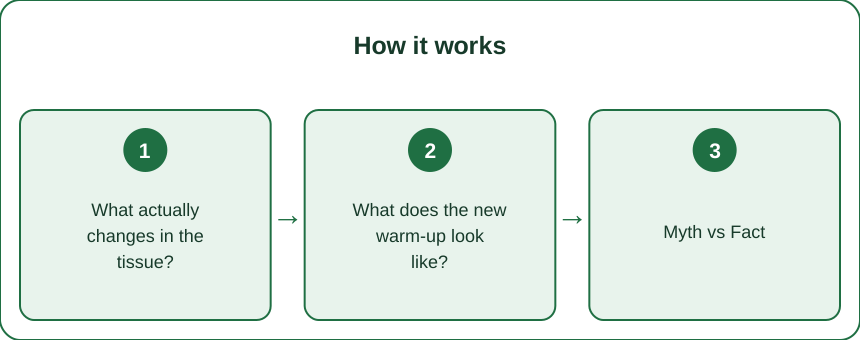
What actually changes in the tissue?
Oestrogen has effects well beyond the reproductive system, and connective tissue is one of the places it matters most.
Oestrogen receptors are present in tendon, ligament, and fascia. Oestrogen influences collagen turnover and the water content of connective tissue, which together determine how elastic and compliant that tissue is.
As levels fall and fluctuate through perimenopause, collagen synthesis and tissue hydration both change. The practical effect is tissue that is stiffer at rest and takes longer to reach a compliant, working state.
Muscle is affected differently. Muscle warms and becomes compliant relatively quickly with activity, largely through increased blood flow and temperature. Tendon is slower, and it is tendon stiffness that produces the specific complaint of the first set or the first ten minutes feeling wrong.
Blood flow redistribution also slows. Getting blood from the core to working muscle takes a little longer, which is part of why cardiovascular warm-ups feel less effective at the same duration.
And there is a temperature component. Perimenopause changes thermoregulation in several ways, and a body that is regulating temperature differently is warming its periphery on a different schedule than it used to.
None of this is damage or decline. It is a change in the time constant, not a change in capacity. The same session is available — it just needs a longer runway.
What does the new warm-up look like?
Roughly double the duration, with the extra time going into progressive loading rather than stretching.
The structure that works:
Phase 1 — general (4 to 5 minutes). Easy cardiovascular work at a genuinely easy effort. Bike, row, brisk walk. The goal is temperature, not fatigue. Slightly warm, breathing a little deeper, nothing more.
Phase 2 — mobility through range (3 to 4 minutes). Dynamic, not held. Leg swings, arm circles, hip circles, cat-cow, thoracic rotations. Static stretching before training is the wrong tool here — held stretches do not warm tissue and can temporarily reduce force output.
Phase 3 — movement-specific ramping (5 to 6 minutes). This is the phase people skip and it is the one that matters most.
For strength work:
- Empty bar or very light, 10 reps of the movement you are about to do
- 40 percent of working weight, 5 reps
- 60 percent, 3 reps
- 80 percent, 2 reps
- Then your working set
For running:
- Five minutes of walking, then five minutes of easy jogging, then start
- Do not begin at target pace. The first kilometre being slower than the rest is now the plan rather than a failure.
Total: 12 to 15 minutes. That is genuinely twice what most people were doing, and it is the change that resolves most of this.
The trade-off is real: if your session is 45 minutes, a 15-minute warm-up is a third of it. Take the time from the session rather than from the warm-up. Four well-warmed working sets produce more than six poorly-warmed ones, and they carry considerably less injury risk.
Myth vs Fact: Warming Up in Perimenopause
Myth: needing a longer warm-up means losing fitness. Fact: it means the time constant changed, not the capacity. Once warm, working capacity is frequently unchanged. The difference is entirely in how long it takes to get there.
Myth: more stretching will fix the stiffness. Fact: static stretching before training does not warm tissue and can temporarily reduce force production. Dynamic movement through range does warm it. Save static stretching for after, or for a separate session.
Myth: if it still feels stiff after warming up, push through. Fact: stiffness that has not eased after a full warm-up is worth respecting. Reduce load for that session rather than proceeding as planned — this is the single most common route to a tendon problem in this age group.
Myth: this is temporary and will resolve after menopause. Fact: connective tissue properties change and remain changed. The good news is that loading maintains tendon quality, so continued resistance training is protective. The longer warm-up is a permanent adjustment, not a phase to wait out.
Myth: it is the same on every day. Fact: it varies considerably, particularly if you are still cycling. Some days need 20 minutes and some need 10, and learning to read that is more useful than fixing a number.

How do you know when you are actually warm?
Use signs rather than a stopwatch, because the requirement genuinely varies day to day.
The markers that indicate readiness:
- The movement feels the same on rep 5 as on rep 1 of your ramping sets. If rep 1 feels notably heavier, you are not warm yet.
- Joint noise has settled. Clicking and crunching that eases with movement is common and usually not concerning; the point is that it typically settles as tissue warms.
- You are slightly sweaty, or at least noticeably warm at the skin.
- The first working set feels like a first working set, not like a third.
The signs you need more time:
- Stiffness that has not changed after ten minutes
- A joint that aches rather than feeling merely stiff
- The ramping sets feeling progressively harder rather than easier
Day-to-day variation to expect:
- Mornings need longer than evenings — often considerably. Tissue is at its stiffest on waking.
- Cold weather needs longer. Autumn and winter sessions genuinely require more warm-up than summer ones, and this catches people out every September.
- Poor sleep needs longer. Sleep quality affects next-day stiffness noticeably in perimenopause.
- The days before a period are often stiffer, though this varies a great deal between individuals.
A practical rule: if in doubt, add five minutes. The cost of over-warming is a slightly shorter session. The cost of under-warming is a tendon that takes six weeks to settle.
This is general information, not medical advice.
What else helps beyond the warm-up itself?
Three things, in order of how much difference they make.
Consistent resistance training. Loading is what maintains tendon and bone quality, and both are under pressure in this phase. Two to three sessions per week, 3 sets of 8 to 10 on compound movements, is the single most protective thing available. The evidence for resistance training through perimenopause has strengthened considerably and it addresses bone density, muscle mass, insulin sensitivity, and tendon quality simultaneously.
Protein intake. Collagen synthesis and muscle protein synthesis both require adequate protein, and requirements tend to rise rather than fall with age. Spreading intake across meals rather than concentrating it in the evening improves utilisation.
Not skipping days entirely. Tissue that is loaded regularly stays more compliant than tissue that is loaded twice a week with long gaps. A short easy session on an off day frequently makes the next real session feel better, and this is more true in perimenopause than it was before.
What matters less than people think: specific supplements marketed for joint comfort have limited and inconsistent evidence, and none of them substitute for warming up properly. Collagen supplementation combined with loading has some supporting evidence for tendon adaptation, though it is not conclusive and it is not a replacement for the loading itself.
And a genuine one: if joint pain is significant, persistent, or waking you at night, discuss it with a clinician rather than managing it as a training problem. Perimenopausal joint pain is common and there are treatment options, including discussion of HRT where appropriate, which is a conversation worth having rather than assuming.
This is general information, not medical advice.
FAQ: Perimenopause Training Questions, Answered
Does this mean I should train less?
No — the opposite, generally. Resistance training becomes more important during this phase, not less, for bone density and muscle mass. What changes is how you enter each session, not how much you do overall.
Is morning training still a good idea?
It is fine, it just needs a longer warm-up. Tissue is stiffest on waking, so a morning session needs the fuller version. If mornings are the only realistic time, build in the extra ten minutes rather than moving the session.
Why does it feel worse in autumn?
Cooler ambient temperature means tissue starts colder and takes longer to warm. It is a real effect and it is why September is when many people first notice this — the change in the weather coincides with a change they had been getting away with.
Should I warm up before a walk?
For an easy walk, the first five minutes are the warm-up. For a brisk or hilly walk, starting slowly for the first five to ten minutes serves the same purpose and is worth doing deliberately rather than setting off at pace.
TL;DR: Same capacity, longer runway.
- Falling oestrogen changes connective tissue hydration and elasticity, so tendon takes longer to reach working state than muscle does.
- Most people need roughly double the warm-up — 12 to 15 minutes rather than 5 to 8.
- Spend the extra time on progressive loading (empty bar, 40%, 60%, 80%) rather than on stretching.
- Static stretching before training is the wrong tool; dynamic movement through range is the right one.
- Judge readiness by whether rep 5 feels like rep 1, not by the clock. Mornings and cold weather need longer.
Take the extra time from the session, not from the warm-up. Four well-warmed sets beat six cold ones, and they do not cost you six weeks of tendon recovery.
Keep Reading
This article is for general informational purposes only and is not medical advice. Always consult a qualified health professional for guidance specific to you.