Why Workout Recovery Slows in Perimenopause, and What Actually Helps
Quick Answer: Estrogen is not just a reproductive hormone — it is deeply involved in muscle repair, inflammation control, and sleep architecture. As levels swing and trend downward through perimenopause, post-workout muscle damage repairs more slowly, inflammation lingers, and the fragmented sleep of the hormonal transition undercuts the very window where repair happens. The fix is not training less; it is recovering on purpose — more protein than you think, wider spacing between hard sessions, and treating sleep as part of the program rather than what happens after it.
This is general information, not medical advice — persistent or severe symptoms deserve a clinician who takes perimenopause seriously.
The frustrating part is that the old rules worked for twenty-five years. Here is why they expired, and what the new rules are.

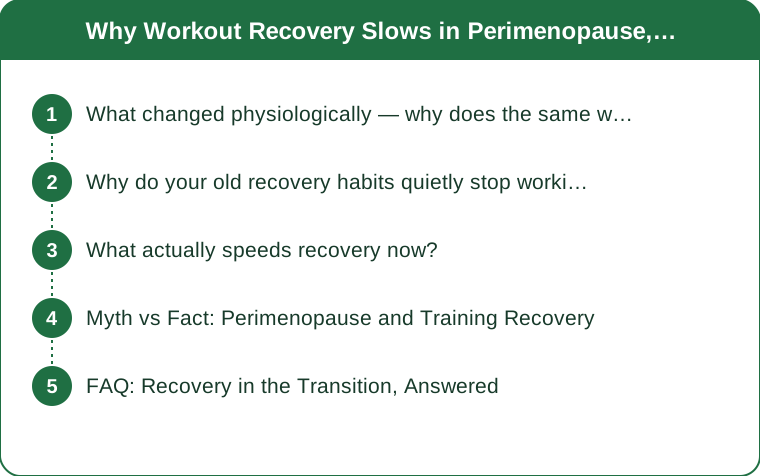
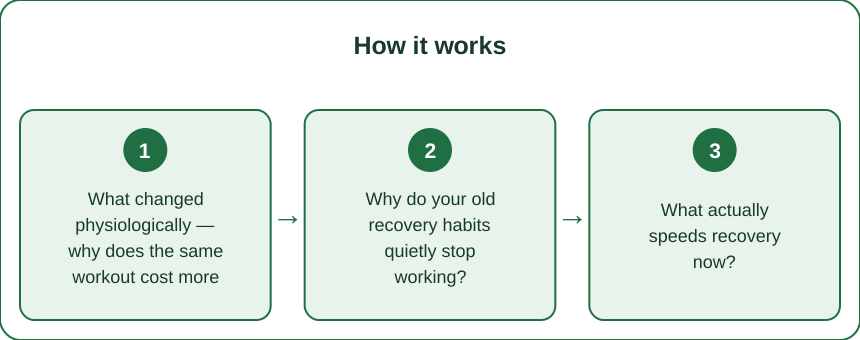
What changed physiologically — why does the same workout cost more now?
Three repair systems all took the same hit.
Estrogen participates directly in muscle repair. Muscle tissue carries estrogen receptors, and the hormone supports the satellite cells that rebuild fibers after training stress. It also stabilizes muscle cell membranes, limiting how much damage a hard session inflicts in the first place. With levels swinging and trending down, the same workout now causes slightly more damage and rebuilds from it more slowly — which you experience as soreness that arrives on schedule but overstays.
Inflammation resolves more sluggishly. Estrogen has anti-inflammatory effects, and its decline shifts the body’s baseline toward a slightly more inflamed state. The acute inflammation of training — normal and necessary — now sits on top of a higher floor and clears down to it more slowly. Lingering stiffness and that heavy-legged feeling into day two and three is this, made flesh.
Sleep, the repair window itself, is under attack from the same source. Night sweats, 3am waking, and lighter sleep architecture are among the most common perimenopause symptoms — and deep sleep is when growth hormone pulses and the bulk of tissue repair runs. The transition simultaneously increases your need for recovery and degrades the machinery that delivers it.
None of this means fragility. It means the recovery half of training, which you could previously ignore, now has to be run deliberately.
Why do your old recovery habits quietly stop working?
Because they were calibrated on a different body, and the calibration was invisible.
Through your twenties and thirties, recovery was fast enough that guessing worked: sore today, fine tomorrow, class again the next morning. That created habits — daily back-to-back classes, protein as an afterthought, sleep as negotiable — that were never actually good; they were merely affordable. Perimenopause changes the prices, and the habits start bouncing.
The classic failure pattern is the loyalist: someone who has taken the same five-days-a-week high-intensity class for a decade, now feeling flatter each month, sorer each week, and responding the only way effort-minded people know — by pushing harder. But under-recovered training does not build; it just accumulates. Performance drifts down, cortisol drifts up, sleep gets worse, and the spiral gets blamed on age when it is actually arithmetic.
The second failure is subtler: interpreting slower recovery as a stop sign. Muscle and bone respond to challenge at every age, and perimenopause is precisely when strength training pays its highest dividends — for bone density, body composition, insulin sensitivity, and symptom management. Backing off to only gentle movement solves the soreness and forfeits the decade.
The correct move is neither harder nor softer. It is the same or greater stimulus, spaced and supported like the recovery now costs what it costs.

What actually speeds recovery now?
Five levers, in rough order of payoff.
Protein, at a dose that surprises people. Aging muscle becomes less responsive to small protein doses — the threshold to trigger repair rises. Aim for roughly 30 grams per meal, three times a day, with one dose within a couple of hours after training. Most women mid-transition are eating half that, and it shows up as exactly this symptom.
Space the hard days. Keep intensity, add daylight between doses: hard-easy-hard beats hard-hard-rest. Forty-eight hours between sessions that target the same muscles is the new default, and a genuinely easy day — walking, mobility, an unhurried swim — recovers better than a zero day.
Guard the sleep window like a training session. A cooler bedroom than you used to need, lighter breathable sleepwear and bedding, alcohol moved away from bedtime (it amplifies both night sweats and waking), and a consistent wind-down. If night sweats and 3am waking are wrecking most nights, that is a clinician conversation — treating the sleep disruption is treating the recovery problem.
Lift, even though lifting is what makes you sore. Two or three strength sessions a week is the highest-value training investment of the decade; comfortable clothes you can actually move in — supportive shoes, high-waisted leggings that stay put through a squat — remove the small frictions that become skip-excuses.
Add the boring accelerants. Post-workout food you do not skip, water across the day, and ten minutes of easy walking after hard sessions to keep blood moving. Unfancy, cumulative, effective.
Myth vs Fact: Perimenopause and Training Recovery
Myth: Slower recovery means you should switch to gentle exercise only. Fact: It means recovery needs managing, not that stimulus needs removing. Strength and impact-appropriate training are exactly what protect bone and muscle through the transition — the dose spacing changes, the challenge stays.
Myth: Soreness that lasts three days means damage or injury. Fact: Extended ordinary soreness is the expected signature of slower repair. Sharp pain, one-sided swelling, or soreness past five days is a different category — that gets assessed.
Myth: Protein matters less as you age. Fact: Precisely backwards — the anabolic threshold rises, so each meal needs more protein to trigger the same repair. This is one of the best-supported changes in the entire field.
Myth: If sleep is broken anyway, training harder will fix it by exhausting you. Fact: Piling training stress onto broken sleep raises cortisol and usually fragments sleep further. Fix flows the other direction: recovery management first, and sleep quality typically improves alongside.
Myth: Supplements are the answer to slow recovery. Fact: Nothing in a capsule outperforms protein dose, session spacing, and sleep. Creatine has decent evidence as a supporting player for muscle and recovery in midlife women — as an addition to the levers, never a substitute.
This is general information, not medical advice.
FAQ: Recovery in the Transition, Answered
How much longer should recovery take now?
A rough working rule: whatever your thirties baseline was, add 50 to 100 percent. Same-day bounce-back becomes next-day; one-day soreness becomes two. Individual variation is wide — track your own pattern for a month and program to it rather than to memory.
Is it perimenopause or am I overtraining?
The symptoms overlap heavily — fatigue, poor sleep, flat performance — and they compound each other. A two-week experiment settles a lot: halve volume, hold protein and sleep steady, and watch. Big improvement points to load; little change points hormonal, and toward a clinician conversation.
Does HRT change recovery?
Some women report meaningful improvements in sleep, joint comfort, and training tolerance on hormone therapy; evidence on direct muscle-recovery effects is still developing. It is a personalized medical decision with your clinician — not a training hack.
What single change gives the fastest visible result?
For most women: hitting 30 grams of protein three times daily for three weeks. It is measurable, entirely in your control, and the most common gap. Sleep repair is the bigger lever but the slower fix.
This is general information, not medical advice.
TL;DR:
- Estrogen supports muscle repair, inflammation control, and deep sleep — perimenopause taxes all three at once, so the same workout costs more.
- The old habits were never good, just affordable; the new price list demands deliberate recovery.
- Levers in order: 30g protein three times daily, 48 hours between hard sessions on the same muscles, sleep guarded like training, keep lifting, easy movement on off days.
- Slower recovery is a management problem, not a stop sign — backing off to gentle-only forfeits the decade that needs strength most.
Run the protein experiment for three weeks — 30 grams, three times a day, logged honestly. It is the cheapest, fastest answer to whether your recovery problem is hormonal weather or a fixable gap.
This is general information, not medical advice.
Keep Reading
This article is for general informational purposes only and is not medical advice. Always consult a qualified health professional for guidance specific to you.