Why Perimenopause Makes Recovery Between Workouts Noticeably Slower Than It Used to Be
Quick Answer: Declining and fluctuating estrogen during perimenopause affects collagen production, inflammation regulation, and sleep quality, all of which play a direct role in how quickly muscles repair after exercise, meaning the same training that once produced minimal next-day soreness can now require noticeably more recovery time — this is a real hormonal shift, not a sign you’re suddenly out of shape.
If recovery has genuinely changed even though your training hasn’t, perimenopausal hormone shifts are a well-documented, real contributing factor.
This is general information, not medical advice — talk with your doctor about symptoms that concern you.

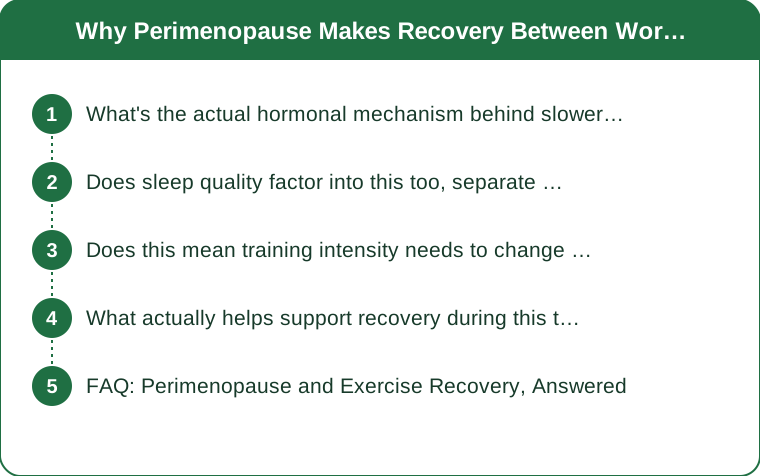
What’s the actual hormonal mechanism behind slower recovery here?
Estrogen plays a role in collagen synthesis, inflammation regulation, and muscle repair processes, and its decline and fluctuation during perimenopause can measurably slow how efficiently these repair processes occur compared to more stable hormone levels earlier in life.
Does sleep quality factor into this too, separate from the direct hormonal effect on muscle?
Yes, significantly — perimenopause frequently disrupts sleep quality, and since muscle repair happens substantially during deep sleep, sleep disruption compounds the direct hormonal effect on recovery, making the combined impact larger than either factor alone.

Does this mean training intensity needs to change during perimenopause?
Not necessarily reduced, but often restructured with more attention to recovery time between hard sessions — the same intensity may need an extra rest day or lighter session inserted where it previously wasn’t needed.
What actually helps support recovery during this transition?
Prioritizing protein intake, sleep hygiene, and strategic rest day placement, along with strength training specifically (which supports the collagen and muscle maintenance affected by hormone changes), all help offset the slower baseline recovery.
FAQ: Perimenopause and Exercise Recovery, Answered
Should I reduce workout frequency overall during perimenopause?
Many people find adjusting rest day placement, rather than overall frequency, addresses the issue without needing to train less overall.
Does strength training help or worsen this recovery issue?
Strength training generally helps, since it directly supports the muscle and bone maintenance that hormonal changes affect, though adequate recovery time between sessions matters more than before.
Is this recovery change permanent through menopause and beyond?
Some adaptation and improved management is possible over time, though the underlying hormonal shift is a lasting change worth planning training around long-term.
TL;DR:
- Declining, fluctuating estrogen affects collagen and inflammation processes tied to muscle repair
- Sleep disruption during perimenopause compounds the direct effect on recovery
- Training structure, not necessarily intensity, often needs adjustment during this transition
- Protein intake, sleep hygiene, and strategic rest days help offset the slower baseline
- This is general information, not medical advice — talk with your doctor about your specific symptoms
Keep Reading
This article is for general informational purposes only and is not medical advice. Always consult a qualified health professional for guidance specific to you.