Why Perimenopause Makes Your Heart Race During Ordinary Workouts
Quick Answer: Fluctuating estrogen during perimenopause affects heart rate regulation and can raise both resting and exercise heart rate at the same workout intensity you’ve always done — it’s a real, common physiological shift, not a sign your fitness has suddenly declined.
The same walk, the same weights, the same pace you’ve done for years — and suddenly your heart rate reads 15-20 beats higher than it used to for that exact effort. That’s not deconditioning. For a lot of women, that’s perimenopause.

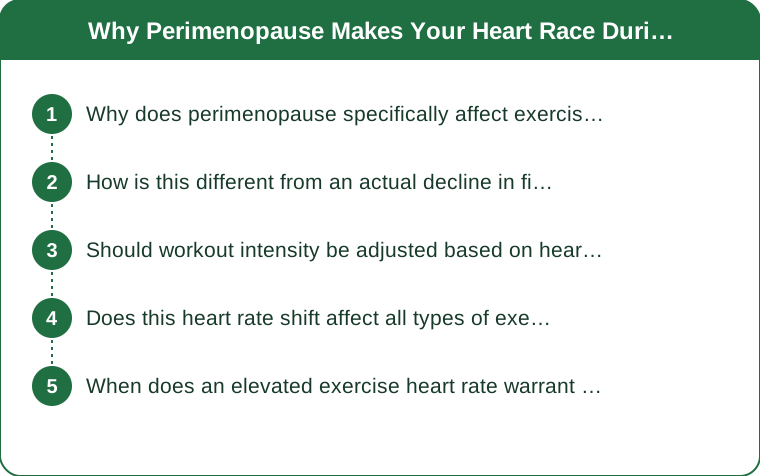
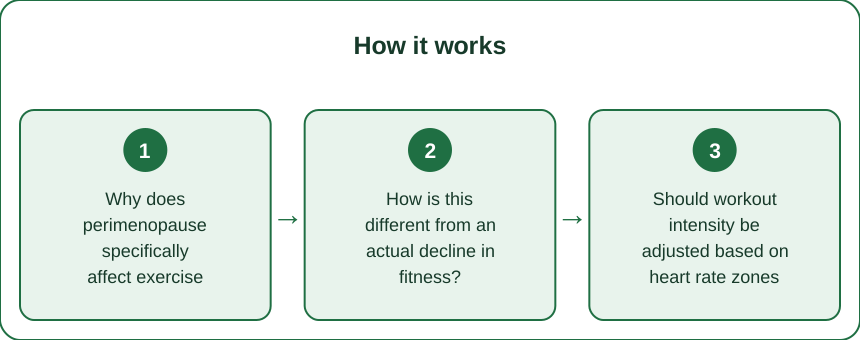
Why does perimenopause specifically affect exercise heart rate?
Estrogen plays a role in cardiovascular regulation, including how the autonomic nervous system manages heart rate. As estrogen fluctuates and gradually declines during perimenopause, heart rate response to the same exercise intensity can shift upward for many women, independent of any actual change in cardiovascular fitness.
How is this different from an actual decline in fitness?
A genuine fitness decline usually comes with reduced overall exercise tolerance — feeling winded faster, needing longer recovery, reduced capacity over time. A perimenopause-related heart rate shift can happen while overall exercise capacity and performance stay largely intact — the number looks different, but the actual workout doesn’t feel proportionally harder in the same way true deconditioning does.

Should workout intensity be adjusted based on heart rate zones that now feel outdated?
Many women find that older heart rate zone calculations (which weren’t designed with perimenopausal hormonal shifts in mind) no longer accurately reflect true effort during this transition. Using perceived exertion — how hard the workout actually feels — alongside heart rate, rather than heart rate zones alone, gives a more accurate read during this period.
Does this heart rate shift affect all types of exercise equally?
Not necessarily equally — some women notice it more during higher-intensity efforts, others notice it even during previously easy, low-intensity activity. The pattern varies enough between individuals that tracking your own personal trend over a few weeks is more useful than comparing to a general rule.
When does an elevated exercise heart rate warrant a doctor’s evaluation rather than being attributed to perimenopause?
If the increase is dramatic, comes with chest pain, dizziness, or unusual shortness of breath, or persists alongside other concerning symptoms, it’s worth a medical evaluation to rule out other causes rather than assuming perimenopause explains everything.
TL;DR:
- Fluctuating estrogen during perimenopause can raise exercise heart rate independent of fitness
- This differs from true deconditioning, which comes with reduced overall exercise capacity
- Perceived exertion alongside heart rate gives a more accurate read during this transition
- Dramatic increases or concerning symptoms warrant a doctor’s evaluation, not assumption
This is general information, not medical advice — a persistently elevated heart rate paired with other symptoms deserves a professional look rather than being chalked up to perimenopause by default.
Keep Reading
This article is for general informational purposes only and is not medical advice. Always consult a qualified health professional for guidance specific to you.