Why Coffee Suddenly Affects You Differently in Perimenopause
Quick Answer: Caffeine feels different in perimenopause for three converging reasons: sleep is already more fragmented, so caffeine’s disruption lands on a thinner margin; hormonal fluctuation affects how caffeine is metabolised and how long it lingers; and caffeine can trigger or worsen hot flushes in people who are already heat-sensitive. The practical change for most people is not quitting, it is a hard cut-off around 8 to 10 hours before bed and watching total daily dose rather than cup count. This is general information, not medical advice.
You have had the same coffee routine for fifteen years.
Now the second cup means you are awake at 2am, and the post-gym one makes you flush.
The coffee did not change.

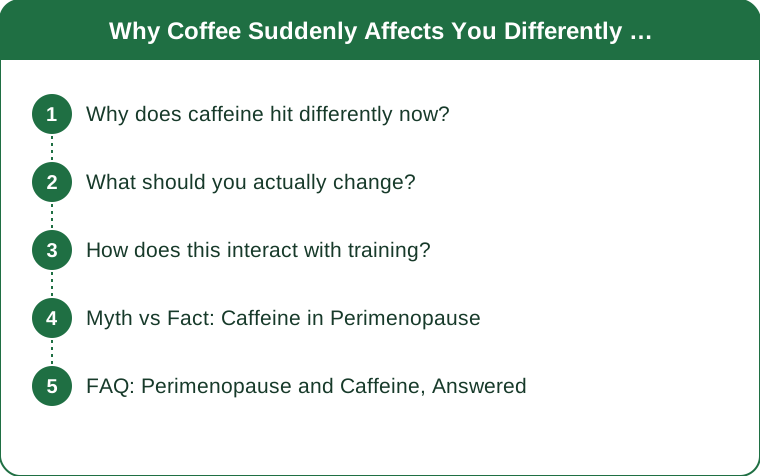
Why does caffeine hit differently now?
Three separate mechanisms, and they compound.
Sleep is already fragmented. Perimenopausal sleep disruption is extremely common, driven by night sweats, hormonal fluctuation and early waking. Caffeine reduces deep sleep and increases wake-after-sleep-onset in everyone, but if your sleep is already fragile, the same dose does noticeably more damage.
Caffeine’s half-life is long and variable. Typical half-life is around 5 to 6 hours but the range across individuals is wide, and it is affected by hormonal status, medications, smoking status and liver enzyme activity. Hormonal contraceptives and fluctuating oestrogen both influence the enzymes involved.
Heat regulation is more sensitive. Caffeine is a stimulant that raises heart rate and can trigger flushing in people prone to vasomotor symptoms. Many people find caffeine a personal hot flush trigger even at doses they tolerated for years.
Anxiety sensitivity often increases. Perimenopause commonly brings heightened anxiety, and caffeine reliably amplifies it. The heart-racing sensation many people describe after coffee is more noticeable when baseline anxiety is higher.
Tolerance is not protective for sleep. You can feel completely unaffected while your sleep architecture is measurably disrupted. Not feeling wired is not evidence that caffeine is not costing you.
And the timing of your day may have shifted. Earlier waking often means the afternoon coffee moved later relative to your actual bedtime, without you changing anything.
What should you actually change?
Timing first, then dose, then only consider quitting.
Set a hard cut-off. For fragmented sleep, 8 to 10 hours before bed is more useful than the commonly cited six. If you sleep at 11pm, that means nothing after 1pm to 3pm.
Count milligrams, not cups. A large coffee-shop americano can be 150 to 225mg; a home cup might be 80. Two cups is not a dose, it is a guess.
Watch the hidden sources. Green tea, some pain relievers, chocolate, pre-workout formulas and energy drinks all contribute. Pre-workout products in particular are frequently the actual cause of an evening sleep problem.
Test rather than assume for hot flushes. Cut caffeine entirely for two weeks, then reintroduce a single morning coffee. If flushes clearly track with it, you have your answer for your body specifically.
Do not quit abruptly if you drink a lot. Withdrawal headaches and fatigue lasting several days are common. Taper by roughly a quarter every few days.
Keep the morning one if it works. Morning caffeine is the least disruptive, has real cognitive benefit and is a genuine pleasure. The evidence-based target is timing and total dose, not abstinence.

How does this interact with training?
Caffeine is one of the best-supported performance aids there is, which makes the trade-off genuinely awkward.
The performance benefit is real. Caffeine reliably improves endurance performance and perceived exertion at doses around 3mg per kg of body weight, and that does not stop being true in perimenopause.
But evening training is where the conflict lives. A 6pm session with pre-workout caffeine puts a substantial dose in your system at exactly the wrong hour for already-disrupted sleep.
Post-exercise flushing gets worse. Perimenopause commonly reduces heat tolerance, and combining exercise heat with a stimulant is a reliable way to produce a flush that outlasts the session.
Sleep loss costs more than caffeine gains. For most people training for health rather than competition, the arithmetic favours protecting sleep. A slightly worse session beats a worse night.
Move the caffeine, not the training. If you train in the evening, take your caffeine in the morning and train without it. Most people lose less than they expect.
Seasonal note: as autumn arrives and mornings get darker, people commonly add a second or third coffee to fight the dark-morning sluggishness. That extra cup is usually consumed later in the day than the first two, which is exactly the one that reaches bedtime. If your sleep worsens in October, look at the schedule change, not just the season.
Myth vs Fact: Caffeine in Perimenopause
Myth: If caffeine does not keep you awake, it is not affecting your sleep
Fact: Caffeine reduces deep sleep even when you fall asleep normally. Subjective alertness is a poor guide.
Myth: Decaf is caffeine-free
Fact: Decaf typically contains 2 to 15mg per cup. Not nothing, but rarely enough to matter for sleep.
Myth: Caffeine causes hot flushes
Fact: It is a common trigger for some people and irrelevant for others. Individual testing beats general rules here.
Myth: You build tolerance so timing stops mattering
Fact: Tolerance develops to the subjective stimulation, not to the sleep-architecture effects.
Myth: Tea is a safe alternative
Fact: Strong black tea can reach 50 to 90mg, and multiple cups through the afternoon adds up to a meaningful dose.
Myth: Quitting caffeine will fix perimenopausal sleep
Fact: It helps at the margin. Night sweats, early waking and hormonal fluctuation are the larger drivers, and they need their own strategies.
FAQ: Perimenopause and Caffeine, Answered
How late is too late for coffee?
With fragmented sleep, aim for a cut-off 8 to 10 hours before your intended sleep time.
How much caffeine is reasonable?
General guidance sits around 400mg a day for most healthy adults, but perimenopausal sleep sensitivity often means a lower personal ceiling.
Will quitting help my hot flushes?
For some people clearly, for others not at all. A two-week elimination and single-variable reintroduction gives you a real answer.
Does caffeine affect bone health?
Very high intakes have been associated with modest effects on calcium balance, which matters more when bone loss accelerates. Moderate intake with adequate calcium is generally not considered a concern.
Can I still use caffeine for workouts?
Yes, and it still works. Take it in the morning and train in the morning where possible, or train without it in the evening.
When should I speak to a doctor?
If heart palpitations, persistent insomnia or severe anxiety are present, discuss it rather than adjusting caffeine alone. This is general information, not medical advice.
TL;DR:
- Caffeine feels stronger because sleep is already fragmented and there is less margin to lose.
- Metabolism and half-life vary, and hormonal fluctuation influences both.
- It is a common hot flush trigger for some people — test with a two-week elimination.
- Set a cut-off 8 to 10 hours before bed and count milligrams, not cups.
- Move caffeine to the morning rather than dropping evening training.
Keep the morning coffee. It is the afternoon one that is costing you the night.
Keep Reading
This article is for general informational purposes only and is not medical advice. Always consult a qualified health professional for guidance specific to you.