Why Perimenopause Changes How Alcohol Affects Sleep and Training
Quick Answer: Alcohol affects perimenopausal sleep more severely because it fragments sleep in the second half of the night, exactly when night sweats and 3am waking already occur, and because alcohol triggers vasodilation that worsens hot flashes. It also suppresses the deep sleep stages most important for recovery, which is why training the next day feels disproportionately flat. Metabolism of alcohol slows modestly with age too. The effect is real, it is not imagined, and most people find that reducing the amount and moving it earlier in the evening restores most of the difference.
You did not change how much you drink. You had the same two glasses you have had for twenty years.
And now you wake at 3am wide awake and overheating, and the session you had planned the next morning feels like wading through mud. This is one of the most consistently reported perimenopause changes and one of the least discussed.

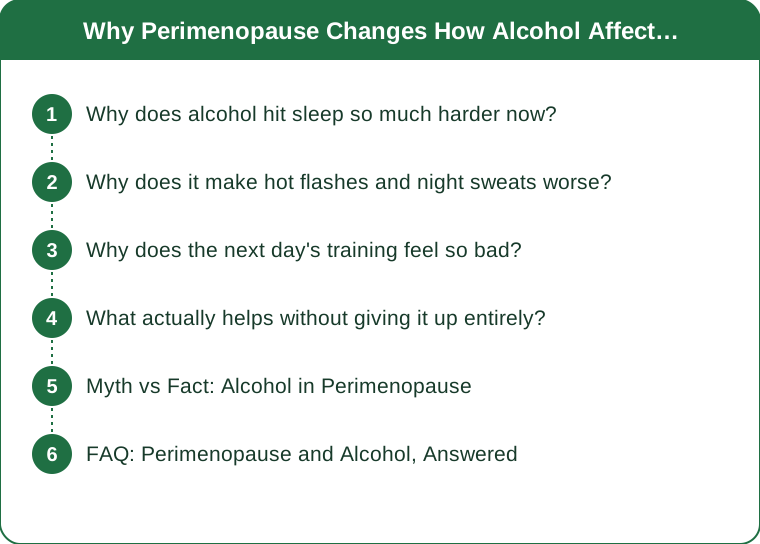
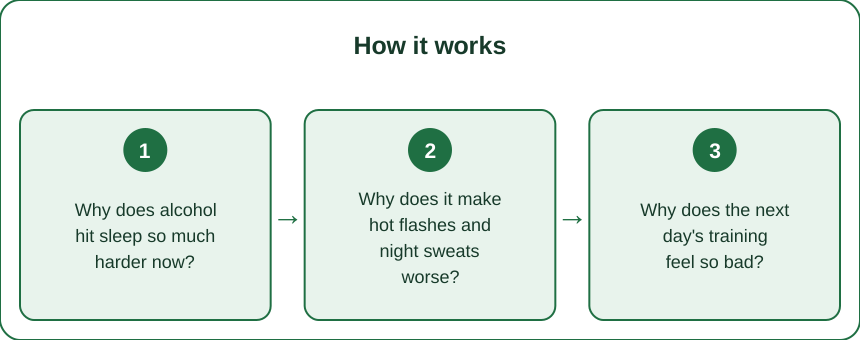
Why does alcohol hit sleep so much harder now?
Because it disrupts sleep in the exact window that perimenopause already disrupts.
Alcohol has two opposite effects across the night. It is sedating initially, so people fall asleep faster. Then as it is metabolised, there is a rebound effect: sleep becomes fragmented, lighter, and prone to waking in the second half of the night.
That rebound lands in the small hours. For a drink finished at 9pm, the disruption phase typically arrives around 2 to 4am. This blog has covered why perimenopause specifically wakes people at 3am, and alcohol places its worst effect precisely on top of that vulnerability.
REM sleep is suppressed. Alcohol reliably reduces REM sleep in the first half of the night, and REM matters for emotional regulation and cognitive processing. This contributes to the next-day flatness that feels out of proportion to the amount consumed.
Deep sleep is affected too. Slow-wave sleep, which is when much of physical recovery happens, is disrupted by alcohol. This is the direct link to how the next day’s training feels.
And the baseline is already lower. Perimenopausal sleep is commonly more fragmented and lighter to begin with. Adding a fragmenting agent to already fragmented sleep produces a much larger practical effect than the same amount would have produced ten years earlier. The alcohol did not get stronger, the margin got thinner.
Why does it make hot flashes and night sweats worse?
Because alcohol does exactly what a hot flash does, chemically.
Alcohol causes vasodilation. Blood vessels near the skin widen, which produces the warm flushed feeling. This is the same physical event that a hot flash consists of, so alcohol is effectively lowering the threshold for one.
The thermoregulatory window is narrower in perimenopause. The range of core temperature the body tolerates before triggering a cooling response appears to narrow, which is a leading explanation for why hot flashes happen at all. Anything that raises core temperature or dilates vessels moves you toward that trigger point more easily.
Alcohol also raises core temperature transiently while impairing the ability to regulate it, which is a poor combination overnight.
Night sweats and alcohol interact badly in sequence. The sweat wakes you, the alcohol rebound keeps you awake, and this blog has covered how hard it is to fall back asleep after a night sweat. Each makes the other worse.
Sugary and mixed drinks may be worse for some people. Blood sugar swings overnight contribute to waking, and drinks with substantial sugar produce a larger swing. This varies considerably between individuals and is worth testing personally.
Red wine is frequently reported as the worst offender. Some of this is likely due to compounds other than the alcohol itself, and the evidence is not strong enough to say anything definitive. Many people find it true for them, which is enough reason to test it.
Why does the next day’s training feel so bad?
Four separate mechanisms, and they do not require a hangover.
1. Reduced deep sleep means reduced recovery. Slow-wave sleep is when most of the physical recovery processes are concentrated. A night with less of it produces a genuinely under-recovered state, regardless of how long you were in bed.
2. Dehydration. Alcohol suppresses antidiuretic hormone, so you lose more fluid. Starting a session mildly dehydrated raises heart rate, raises perceived effort, and reduces performance. Combined with night sweats, the fluid deficit can be substantial.
3. Impaired glycogen replenishment and protein synthesis. Alcohol interferes with the processes that restore muscle fuel and rebuild tissue after training. Drinking after an evening workout is the worst timing from a recovery standpoint.
4. Elevated heart rate and reduced HRV. Alcohol reliably raises resting heart rate overnight and lowers heart rate variability, often for a full 24 hours. This blog has covered how perimenopause already makes the heart race during ordinary workouts, and alcohol compounds it directly. Anyone with a wearable can see this effect in their own data, and it is one of the clearest demonstrations available.
The combined effect explains the disproportion. Two drinks producing a genuinely difficult training day looks like an overreaction until you realise it is four separate systems being nudged at once, on top of a baseline that already has less margin than it did a decade ago.

What actually helps without giving it up entirely?
Timing and quantity, and both are more effective than most people expect.
Move it earlier. Finishing three to four hours before bed lets most of the metabolism happen before you sleep, which substantially reduces the second-half-of-the-night disruption. A drink with dinner at 6pm is a different proposition from the same drink at 9:30pm.
Reduce the amount before eliminating it. For many people the difference between two drinks and one is dramatic, while the difference between one and none is small. Testing your own threshold is worth more than a general rule.
Hydrate deliberately alongside. A glass of water per drink addresses the dehydration component, which is the easiest of the four mechanisms to remove.
Never on the night after a hard session. If you are going to drink, put it on a rest day or an easy day. Drinking after an evening workout interferes with the recovery window directly.
Watch the room temperature. A cooler bedroom, lighter bedding, and layers you can shed reduce how easily the vasodilation crosses the hot flash threshold. This costs nothing and helps regardless of alcohol.
Track it for two weeks. If you use a wearable, note resting heart rate and sleep on nights with and without. Most people find the data more persuasive than any advice, and it identifies your personal threshold rather than a generic one.
A note on where this sits medically. Alcohol interacts with sleep, mood, and cardiovascular health in ways that go beyond the scope of this article, and guidance around alcohol in midlife is a genuine health conversation. If sleep is significantly disrupted, or if you are managing perimenopause symptoms with a doctor, this belongs in that conversation. This is general information, not medical advice.
Myth vs Fact: Alcohol in Perimenopause
Myth: A nightcap helps you sleep. Fact: It helps you fall asleep and worsens the quality and continuity of the sleep that follows. The net effect on how rested you feel is negative, and it is more negative in perimenopause because the second half of the night is already fragile.
Myth: If you do not have a hangover, it did not affect you. Fact: The recovery, sleep architecture, and heart rate effects occur well below hangover thresholds. One or two drinks with no hangover still produce a measurable overnight heart rate elevation and reduced deep sleep.
Myth: Your tolerance dropped because you drink less often now. Fact: Frequency plays a part and it is not the main story. Body composition changes, modestly slower metabolism, and a much narrower sleep and thermoregulatory margin all contribute. The same drink is genuinely doing more.
Myth: Wine is better than spirits for sleep. Fact: The alcohol content is what drives the sleep effects. Many people find red wine worse for hot flashes specifically, which is a separate question from sleep and is worth testing personally.
Myth: You have to give it up entirely. Fact: For most people, moving the timing earlier and reducing the quantity recovers the large majority of the benefit. Framing it as all or nothing is the reason many people change nothing at all.
Myth: This is just aging and applies to everyone equally. Fact: Aging matters, and the perimenopausal change is layered on top of it and is often quite abrupt. People frequently notice a distinct shift within a year, which is not how gradual aging effects usually present.
FAQ: Perimenopause and Alcohol, Answered
Why does alcohol wake me at 3am now when it never used to?
Alcohol fragments sleep in the second half of the night as it is metabolised, and perimenopause independently produces early-hours waking. The two land in the same window, so the combined effect is much larger than either alone.
Does alcohol really make hot flashes worse?
Yes, for many people. Alcohol causes vasodilation, which is the same physical event a hot flash consists of, and it transiently raises core temperature while impairing regulation. It effectively lowers the threshold for a flash.
How long before bed should I stop drinking?
Three to four hours is the practical target, so most of the metabolism happens before you sleep. Moving a drink from 9:30pm to 6pm often changes the night substantially without changing the amount.
Why is my workout so bad the day after just two drinks?
Reduced deep sleep, dehydration, impaired glycogen and protein recovery, and an elevated overnight heart rate that can persist for 24 hours. Four systems affected at once explains why the effect feels disproportionate to the amount.
TL;DR:
- Alcohol fragments the second half of the night, which is exactly where perimenopause already causes waking.
- Vasodilation from alcohol lowers the threshold for hot flashes and night sweats.
- The next-day training slump comes from reduced deep sleep, dehydration, impaired recovery, and elevated overnight heart rate.
- Moving drinks three to four hours earlier and reducing the amount recovers most of the difference without giving it up.
If you wear a tracker, compare two weeks of nights with and without. The data is usually more convincing than any article.
Keep Reading
This article is for general informational purposes only and is not medical advice. Always consult a qualified health professional for guidance specific to you.