Why Perimenopause Changes Your Heat Tolerance Before Anything Else
Quick Answer: Fluctuating estrogen narrows your body’s thermoneutral zone — the temperature range in which you feel comfortable without sweating or shivering. That narrowing often happens years before cycle irregularity, which is why the first noticeable perimenopause symptom for many people is simply not handling August the way they used to.
You have lived in this climate for twenty years. This summer it is unbearable. Your partner is fine, the thermostat has not moved, and you have started keeping a spare shirt in the car. Nothing about your environment changed. Your internal thermostat did.

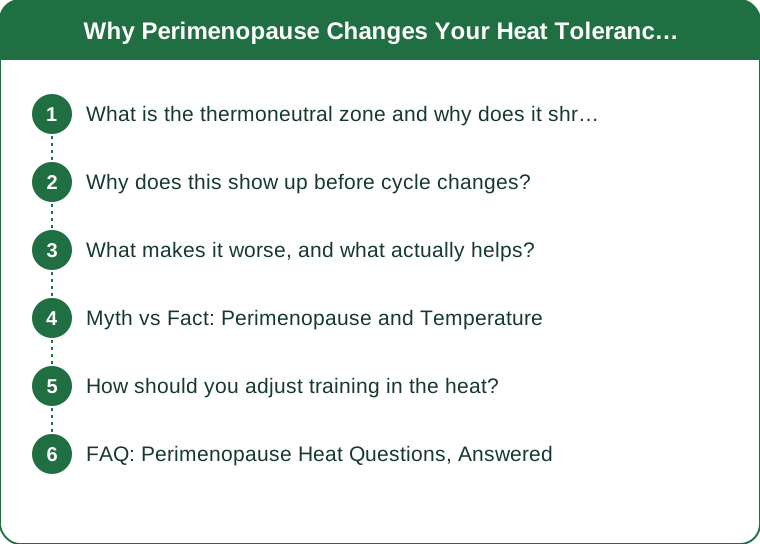
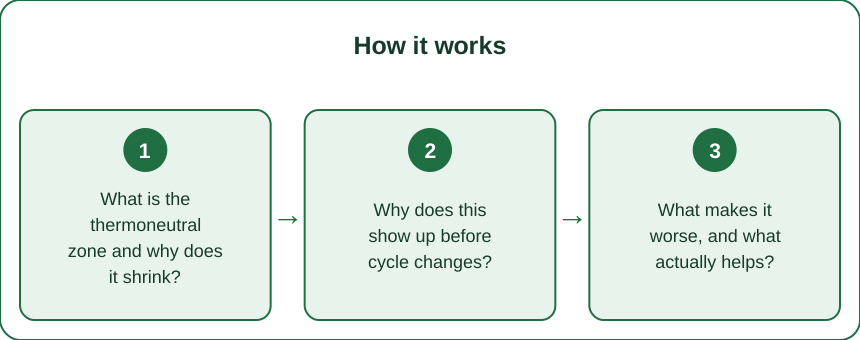
What is the thermoneutral zone and why does it shrink?
Your body maintains core temperature within a narrow band. The thermoneutral zone is the range of core temperatures within which you neither sweat to cool down nor shiver to warm up. In a typical premenopausal woman, that zone is relatively wide — you can drift a bit in either direction without doing anything about it.
Estrogen influences the hypothalamus, which is where that zone is set. As estrogen begins fluctuating and declining in perimenopause, the zone narrows, in some research to a fraction of its previous width.
The practical consequence: a tiny rise in core temperature that you would previously not have noticed now crosses the sweating threshold immediately. A warm room, a hot drink, a mild workout, or a stressful meeting can all push you across a line that used to be much further away.
This is the same mechanism behind hot flashes. A hot flash is what a crossed threshold feels like when the response is abrupt.
Why does this show up before cycle changes?
Because the hypothalamus is sensitive to estrogen variability, not just to low estrogen.
Early perimenopause is characterized by wide swings — some cycles with higher-than-usual estrogen, some with much lower. Your cycle length can stay entirely normal through this, because ovulation is still happening. Meanwhile the temperature-regulating center is being whipsawed by hormone levels that change week to week.
So the reporting sequence for many people is: heat intolerance and sleep disruption first, mood and anxiety changes second, cycle irregularity third, and everything the internet told them to watch for last.
This is why heat intolerance in your early forties, in someone with regular periods, is so often dismissed or attributed to something else. It is frequently the first sign, and it is a legitimate one.
What makes it worse, and what actually helps?
The triggers are more specific than general heat.
Common amplifiers:
- Alcohol, which dilates blood vessels and disrupts overnight temperature regulation
- Caffeine in the afternoon, which adds a sympathetic nervous system load
- Spicy food and hot drinks, which raise core temperature directly
- Stress, which is probably the most underrated trigger — sympathetic activation narrows the zone further
- Poor sleep, which creates a cycle where night sweats worsen sleep and worse sleep worsens temperature control
What helps most, in rough order:
- Layered, breathable clothing you can remove in seconds without a bathroom trip
- Cooling the environment before the flash, especially at night — a bedroom in the low 60s makes a measurable difference
- Paced breathing, six breaths per minute for a few minutes, which dampens the sympathetic response
- Regular exercise, which improves thermoregulation over time even though individual sessions feel harder
- Consistent sleep timing, which stabilizes the whole system more than any single intervention

Myth vs Fact: Perimenopause and Temperature
Myth: Hot flashes only happen after periods stop. Fact: Vasomotor symptoms often begin years before the final period, sometimes while cycles are still perfectly regular.
Myth: If you are fit, you will not get them. Fact: Fitness improves overall thermoregulation and may reduce severity, but athletic women experience vasomotor symptoms too. It is a hypothalamic setting, not a conditioning problem.
Myth: Feeling cold cannot be perimenopause. Fact: A narrowed thermoneutral zone means you cross the shivering threshold more easily too. Alternating between too hot and too cold in the same afternoon is a classic presentation.
Myth: You just have to wait it out. Fact: Vasomotor symptoms average around seven years and for some people considerably longer. There are effective treatments, both hormonal and non-hormonal, and a clinician is the right person to discuss them with. This is general information, not medical advice.
How should you adjust training in the heat?
The instinct is to push through, and it works poorly here because your cooling capacity has genuinely changed.
Practical adjustments:
- Move hard sessions to the coolest hour available. For most people that is early morning, though in humid climates mid-morning can be better.
- Pre-cool. A cold drink or a cool shower 15 minutes before training measurably extends how long you can work before crossing the threshold.
- Change the metric. Track effort and heart rate rather than pace during hot months, and accept that summer paces will not match spring paces.
- Add sodium. Perimenopausal women often sweat differently than they used to, and plain water in high-sweat conditions can leave you feeling worse.
- Keep the training. This is the important one. Exercise improves long-term thermoregulation, bone density, insulin sensitivity, and sleep — all of which matter more, not less, during this transition.
If symptoms are disrupting your sleep or your work, that is a reason to talk to a clinician rather than a reason to train harder.
FAQ: Perimenopause Heat Questions, Answered
How early can this start?
Perimenopause commonly begins in the early to mid forties, and for some people in the late thirties. Heat intolerance with regular cycles is a recognized early presentation.
Is it definitely perimenopause?
Not necessarily. Thyroid conditions, certain medications, anemia, and anxiety disorders all affect heat tolerance. That is exactly why it is worth mentioning to a clinician rather than self-diagnosing, particularly if it appeared suddenly.
Do hot flashes get worse in summer?
Environmental heat does not cause them, but it does mean you start closer to the threshold, so the same internal trigger crosses it more often. Most people report more frequent flashes in hot weather even though the underlying mechanism has not changed.
TL;DR:
- Fluctuating estrogen narrows the thermoneutral zone, so small temperature changes now trigger big responses
- This often appears years before cycle irregularity, which is why it gets missed
- Alcohol, afternoon caffeine, stress, and poor sleep are the biggest amplifiers
- Keep training, but move it cooler, pre-cool, and track effort rather than pace
If you have spent this summer wondering what is wrong with you, the answer may be nothing beyond a thermostat that has been recalibrated without your consent. It is one of the most common early experiences of this transition and one of the least discussed. Worth mentioning at your next appointment, and worth knowing you are not imagining it.
Keep Reading
This article is for general informational purposes only and is not medical advice. Always consult a qualified health professional for guidance specific to you.