Why Perimenopause Brings Stiff Mornings and Joint Aches That Move Around
Quick Answer: Declining estrogen affects cartilage, tendon, and synovial tissue and increases inflammatory signaling, which produces widespread aching and morning stiffness that often migrates between joints. It is common enough that clinicians refer to it as menopausal arthralgia. Morning stiffness lasting under 30 minutes and moving between joints usually points here; stiffness over an hour with swelling in the same joints needs evaluation for inflammatory arthritis.
Your shoulder hurts for three weeks, then stops, then your hands are stiff every morning for a month. Nothing is injured. This pattern has a name.

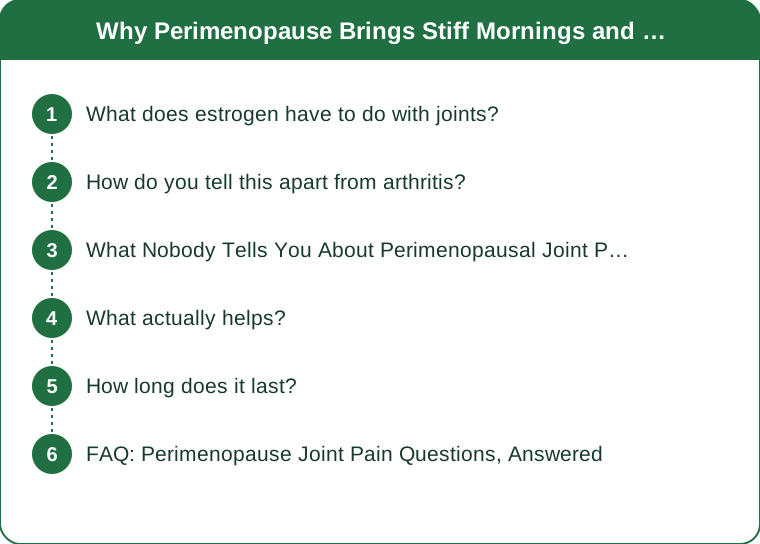
What does estrogen have to do with joints?
Estrogen receptors are present in cartilage, tendon, ligament, synovial membrane, and bone, which means these tissues are directly responsive to hormonal change rather than incidentally affected.
Several things happen as levels decline and fluctuate. Collagen synthesis and turnover change, which affects tendon stiffness and how tissue tolerates load. Synovial fluid characteristics shift, which affects how joints feel first thing in the morning. And estrogen’s anti-inflammatory effects diminish, allowing greater inflammatory signaling.
The fluctuation matters as much as the decline. Perimenopause is characterized by erratic swings rather than a smooth fall, and many people report that symptoms are worst during the volatile years rather than after periods stop entirely.
This is also why the pain migrates. It is not a mechanical problem in one joint that resolves and appears elsewhere. It is a systemic change in tissue environment that expresses itself wherever load and sensitivity happen to align that month.
How do you tell this apart from arthritis?
Four features distinguish menopausal arthralgia from inflammatory arthritis, and they are worth knowing precisely.
Duration of morning stiffness. Menopausal joint aching typically eases within 15 to 30 minutes of moving. Inflammatory arthritis characteristically produces stiffness lasting an hour or more.
Swelling. Visible, persistent swelling and warmth in a joint points away from hormonal aching and toward something that needs assessment.
Pattern. Menopausal symptoms tend to migrate and vary. Rheumatoid arthritis tends to be symmetrical and persistent in the same joints, particularly the small joints of the hands.
Response to movement. Hormonal aching almost always improves with gentle activity and worsens with prolonged stillness. Inflammatory conditions often do not follow this pattern as cleanly.
The honest caveat is that perimenopause and the typical onset age for several inflammatory conditions overlap, so a self-assessment is a starting point rather than a conclusion. If any of the red flags apply, ask for bloodwork rather than assuming hormones.
What Nobody Tells You About Perimenopausal Joint Pain
The frozen shoulder connection is real and underdiscussed. Adhesive capsulitis occurs disproportionately in women in the 40-60 range, and the hormonal association is increasingly recognized. Early loss of shoulder rotation deserves prompt attention rather than waiting, because early intervention meaningfully changes the course.
Tendons get more injury-prone, not just more achy. Changes in collagen turnover mean tendons tolerate sudden load increases less well than they did five years ago. This is the years where people who ramp up running volume the way they always have get an Achilles or gluteal tendon problem for the first time.
It is often worse on the non-dominant side first. Less daily loading means less of the movement that keeps tissue tolerant, so the arm you use less complains sooner. That is counterintuitive to almost everyone.
Sleep disruption amplifies it substantially. Poor sleep lowers pain thresholds measurably, so a night broken by hot flashes produces a genuinely worse morning independent of any change in the joints.
And the one that changes how people manage it: rest makes it worse. The instinct with a painful joint is to protect it. Here, protection increases stiffness, reduces tissue tolerance, and starts a cycle. Gentle, frequent movement is the treatment, not the risk.

What actually helps?
Four things with reasonable support, in rough order of impact.
Resistance training, consistently. This is the highest-value intervention and it addresses several perimenopausal changes at once. Loading tendon and bone maintains their tolerance and density during exactly the window when both are declining. Two to three sessions a week, progressive, is the target. Start lighter than your history suggests and progress more slowly than you used to.
Movement frequency over movement volume. Because stiffness accumulates with stillness, breaking up sedentary periods matters more than one long session. Standing and moving for two minutes every hour affects morning stiffness more than people expect.
A morning routine before you get out of bed. Five minutes of gentle range of motion for hands, shoulders, hips, and ankles while still warm shortens the stiff window substantially for many people.
Sleep, treated as a joint intervention. Addressing night sweats and sleep fragmentation improves pain reporting in a way that no supplement matches.
On supplements: evidence for most joint supplements in this specific context is weak. Vitamin D is worth checking because deficiency is common and does affect musculoskeletal pain. Omega-3 has modest anti-inflammatory support. Neither substitutes for loading.
Hormone therapy is a legitimate conversation to have with a clinician, and joint symptoms are a recognized reason people raise it. That decision involves individual risk factors and belongs in a consultation, not an article.
This is general information, not medical advice.
How long does it last?
For most people the aching phase tracks the years of greatest hormonal volatility, meaning it often improves once levels stabilize post-menopause rather than continuing indefinitely.
That is genuinely reassuring and also frustrating, because the volatile phase can run several years. Treating it as a temporary state you manage rather than a permanent decline you accept changes what people are willing to do about it.
The thing worth protecting during this window is capacity. Bone density and muscle mass both decline more rapidly during the menopausal transition, and what you carry into your sixties is largely determined by what you maintain in your forties and fifties.
Which makes the joint aching a scheduling problem more than anything: it arrives at exactly the moment when strength training matters most, and it makes strength training feel least appealing. Working around it rather than waiting it out is the decision that matters.
FAQ: Perimenopause Joint Pain Questions, Answered
Should I stop running?
Usually no. Reduce volume if symptoms are flaring, keep frequency, and add strength work. Stopping entirely reduces tissue tolerance and tends to make the return harder than the original problem.
Why are my hands worst?
The small joints of the hands have a high ratio of synovial tissue to load, and they are also the joints you notice most because they are involved in everything you do first thing in the morning. Hand-specific range of motion work before getting up helps disproportionately.
Is it worth getting blood tests?
Worth asking for if there is persistent swelling, morning stiffness over an hour, symmetrical small-joint involvement, or systemic symptoms like fever or weight loss. Vitamin D and thyroid function are also reasonable to check since both overlap with this symptom picture.
TL;DR:
- Estrogen acts directly on cartilage, tendon, and synovial tissue, so decline produces real, migrating joint symptoms
- Under 30 minutes of morning stiffness that moves around suggests hormonal; over an hour with swelling needs assessment
- Rest worsens it; frequent gentle movement and consistent resistance training are the actual treatments
- It usually eases once hormone levels stabilize, but the window is when strength matters most
If your joints started complaining in your forties and the pain will not stay in one place, this is a recognized pattern. Move more often, lift consistently, and get the red flags checked.
Keep Reading
This article is for general informational purposes only and is not medical advice. Always consult a qualified health professional for guidance specific to you.