Why the Same Coffee Suddenly Keeps You Up in Perimenopause
Quick Answer: Caffeine feels stronger in perimenopause for three reasons: hormonal shifts change how quickly your liver clears it, sleep is already more fragmented so the same disruption costs more, and caffeine can trigger or intensify hot flashes in people who are prone to them. A hard cutoff around eight hours before bed resolves it for most people, without giving up coffee entirely.
The 2pm coffee was a twenty-year habit with no consequences.
Now you are awake at 3am staring at the ceiling and doing the math backwards.

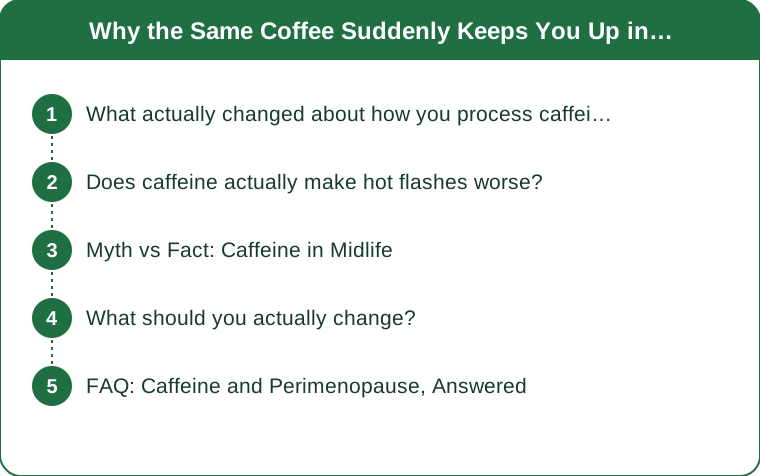
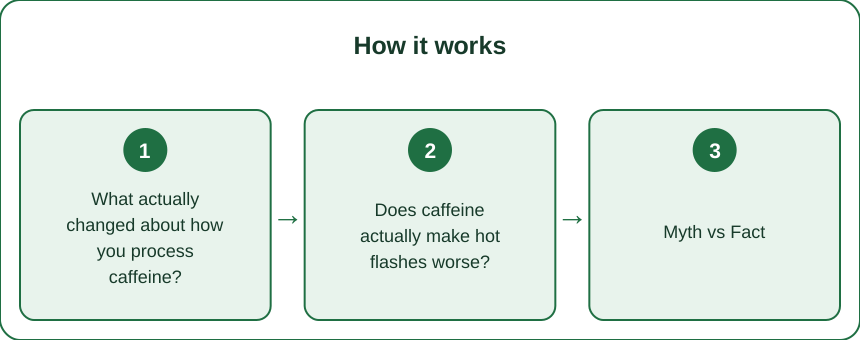
What actually changed about how you process caffeine?
Clearance rate and baseline sleep quality, and they compound.
Caffeine is cleared by a liver enzyme whose activity varies. The enzyme responsible for metabolizing caffeine is influenced by hormones, and the fluctuating estrogen levels of perimenopause can slow clearance. Slower clearance means a higher blood level at bedtime from the same cup.
The half-life is longer than people assume even at baseline. Caffeine’s half-life is roughly five to six hours in most adults. A 2pm coffee still has meaningful caffeine in your system at 10pm. If clearance slows, that window extends further.
Perimenopausal sleep is already more fragile. Sleep in perimenopause tends to be more fragmented, with more awakenings and less deep sleep. Caffeine that would have caused a minor, unnoticed disruption now lands on top of an already-disrupted night.
Caffeine reduces deep sleep even when you fall asleep fine. This is the part people miss. You can be asleep by 11 and still get poorer quality sleep, which shows up as unrefreshing sleep rather than difficulty falling asleep.
And the effect runs in a loop. Poor sleep drives more caffeine the next day, which drives worse sleep. Most people are two or three weeks into this loop before they notice it.
Does caffeine actually make hot flashes worse?
For a meaningful share of people, yes — and it is worth testing on yourself rather than assuming either way.
Caffeine is a common reported trigger. Along with alcohol, spicy food, and warm rooms, caffeine appears consistently on trigger lists that people identify through their own tracking.
The mechanism is plausible. Caffeine raises heart rate and can slightly raise core temperature, and hot flashes involve a narrowed thermoneutral zone where small temperature changes trigger a large response.
Individual variation is enormous. Some people find no connection at all. Others find that removing afternoon caffeine noticeably reduces evening flashes within a week. Neither result is unusual, which is why general advice is less useful than a personal two-week test.
Night sweats and caffeine interact badly. If a hot flash wakes you at 2am, the ability to fall back asleep matters enormously — and residual caffeine makes that return to sleep harder, turning a five-minute wake into a ninety-minute one.
Test properly if you want to know. Two weeks with afternoon caffeine, two weeks without, tracking flashes and night wakings both times. Anything shorter is swamped by normal week-to-week variation.

Myth vs Fact: Caffeine in Midlife
Myth: If you can fall asleep after coffee, it is not affecting your sleep. Fact: Caffeine reduces deep sleep independently of whether it delays sleep onset. Falling asleep normally and waking unrefreshed is one of the most common presentations, and it is why people rule caffeine out incorrectly.
Myth: Decaf solves the problem. Fact: Decaf is not caffeine-free — a cup typically contains a small amount. For most people that is negligible, but for someone with genuinely slowed clearance and fragmented sleep, three cups of decaf in the evening is not nothing.
Myth: You build tolerance, so long-term drinkers are unaffected. Fact: Tolerance develops to the subjective alertness effect much more than to the sleep-disruption effect. This is exactly why a lifelong coffee drinker can feel no buzz at all and still sleep badly from it.
Myth: Green tea is a safe alternative. Fact: Green tea contains meaningful caffeine — usually a third to half of a coffee. It is a reduction, not an elimination, and an evening pot of green tea can easily equal an afternoon coffee.
Myth: You have to quit entirely. Fact: Timing solves this for the large majority of people. Morning caffeine is rarely the problem. A cutoff time preserves the part of the habit you actually value while removing the part that costs you.
What should you actually change?
Timing first, then quantity, and give each change a fair trial.
Set a hard cutoff eight hours before bed. If you sleep at 10:30, that means nothing after 2:30. Most people find this single rule resolves the problem without touching their morning routine.
Move it earlier if eight hours is not enough. Some people in perimenopause need ten or even twelve hours. If a 2:30 cutoff does not help after two weeks, try noon before concluding caffeine is not the issue.
Do not quit abruptly. Withdrawal headaches and fatigue for three to five days will make you conclude the change is not working. Reduce gradually over a week or two if you are cutting total intake.
Watch the hidden sources. Chocolate, some pain relievers, pre-workout supplements, and iced tea all contribute. A late-afternoon pre-workout is one of the most common overlooked culprits, and it often contains more caffeine than a coffee.
Track two weeks before deciding anything. Night wakings, morning refreshment on a one-to-five scale, and hot flash count. Perimenopause symptoms vary so much week to week that anything shorter tells you nothing. Persistent insomnia, or symptoms that meaningfully affect daily function, deserve a professional conversation rather than only a caffeine adjustment. This is general information, not medical advice.
FAQ: Caffeine and Perimenopause, Answered
Is there a safe amount in the morning?
For most people, morning caffeine is fine at typical intakes and is not what is disrupting sleep. The evidence for moderate coffee consumption is broadly favorable. It is timing, not existence, that causes the problem for most people in this stage.
Why did this change so suddenly rather than gradually?
It usually did change gradually — but perception is threshold-based. Sleep degrades slowly until it crosses the point where you notice it, and then it seems to have happened overnight. Looking back, most people can identify six months of slightly worse sleep before the obvious change.
Does the same thing happen with alcohol?
Often, yes, and frequently more dramatically. Alcohol clearance also shifts, and alcohol disrupts the second half of the night in a way that stacks badly with night sweats. Many people find the evening glass of wine became a bigger sleep problem than the afternoon coffee did.
TL;DR:
- Hormonal shifts can slow caffeine clearance, so the same cup produces higher levels at bedtime
- Caffeine reduces deep sleep even when you fall asleep normally — unrefreshing sleep is the tell
- It is a common hot flash trigger for some people; a two-week on/off test is the only way to know yours
- A hard cutoff eight hours before bed fixes it for most people without giving up morning coffee
- Check pre-workout, green tea, and chocolate — the hidden afternoon sources are usually the culprit
The good news in this one is that it is a timing problem with a timing solution. Nobody needs to give up coffee. You just have to move it, and the version of the habit worth keeping was always the morning one anyway.
Keep Reading
This article is for general informational purposes only and is not medical advice. Always consult a qualified health professional for guidance specific to you.