Why Your Workout Recovery Suddenly Takes Longer in Perimenopause
Quick Answer: Declining and fluctuating estrogen during perimenopause reduces its anti-inflammatory effect on muscle tissue, which means the same workout intensity can produce more soreness and take longer to recover from than it did a few years earlier.
If you’ve noticed that workouts which used to leave you refreshed now leave you wiped out for a day or two, you’re not imagining it, and you’re not suddenly out of shape.

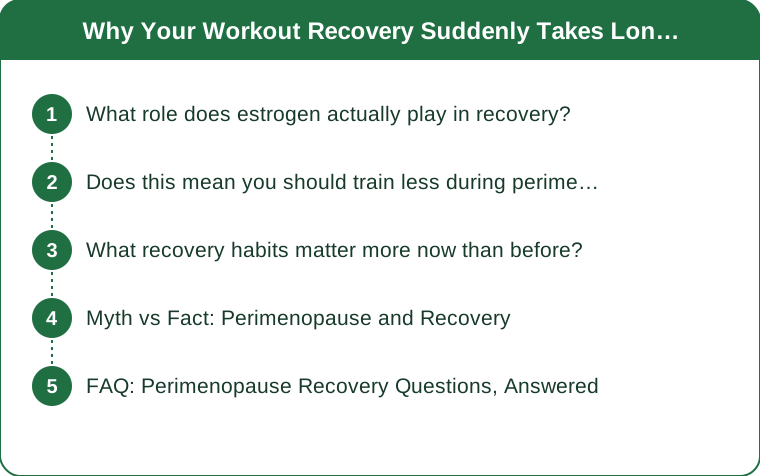
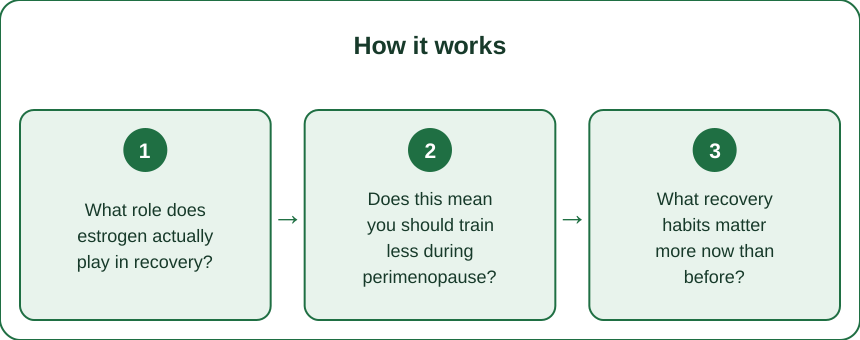
What role does estrogen actually play in recovery?
Estrogen has a measurable anti-inflammatory effect and supports collagen production, both of which help muscle tissue repair efficiently after exercise. As estrogen fluctuates and trends downward during perimenopause, that natural buffering effect weakens, so the same training load can generate more inflammation and take longer to resolve than it used to.
Does this mean you should train less during perimenopause?
Not necessarily less — but likely structured differently, with more attention to recovery time between hard sessions. Many women find that spacing intense workouts 48-72 hours apart, rather than back-to-back, prevents the compounding fatigue that used to be a non-issue. Strength training in particular remains valuable during this stage for bone density and metabolic health, so the goal is smarter scheduling, not less training overall.

What recovery habits matter more now than before?
Protein intake and sleep both carry more weight during perimenopause recovery than most women realize. Aiming for roughly 25-30g of protein within an hour or two of training supports the repair process, and prioritizing 7+ hours of sleep matters more when estrogen’s natural recovery support is diminished. Gentle mobility work on rest days — walking, light stretching — can also help without adding to training fatigue.
Myth vs Fact: Perimenopause and Recovery
Myth: Slower recovery means you should stop strength training. Fact: Strength training remains one of the most protective exercises for bone and muscle health during this stage — the fix is recovery spacing, not avoidance.
Myth: Soreness lasting longer is a sign of overtraining. Fact: It can simply reflect reduced hormonal support for recovery, even at a training load that was previously fine.
Myth: Only cardio fitness declines in perimenopause. Fact: Recovery capacity, sleep quality, and inflammation regulation are all affected, which is why the whole training approach often needs adjusting, not just intensity.
FAQ: Perimenopause Recovery Questions, Answered
How much rest between strength sessions is ideal now?
Many women find 48-72 hours between sessions targeting the same muscle groups works better during perimenopause than the 24-48 hours that felt sufficient before.
Does magnesium help with perimenopause muscle soreness?
Some women report benefit for sleep quality and muscle relaxation, though evidence is mixed — it’s reasonable to discuss with your doctor given individual variation.
Should I switch to lower-intensity workouts entirely?
Not necessarily — moderate-to-high intensity strength work is still valuable; the key adjustment is usually recovery time and sleep priority, not intensity reduction.
TL;DR:
- Declining estrogen during perimenopause reduces its natural anti-inflammatory effect on muscles
- The fix is smarter recovery spacing, not less training overall
- Protein timing and sleep matter more now for recovery than they used to
- Longer soreness doesn’t necessarily mean overtraining — it can just reflect hormonal changes
This is general information, not medical advice — talk with your doctor if fatigue or soreness feels disproportionate to your training.
Keep Reading
This article is for general informational purposes only and is not medical advice. Always consult a qualified health professional for guidance specific to you.