Why Strength Training Should Move to the Top of Your Perimenopause Workout List
Quick Answer: Declining estrogen during perimenopause accelerates muscle and bone density loss, making strength training 2-3x/week a higher priority than it was in your 30s — cardio remains valuable, but it doesn’t address this specific, accelerating loss the way resistance training does.
The cardio routine that worked for years suddenly isn’t producing the same results, and the reason often has less to do with effort and more to do with what your body needs now.

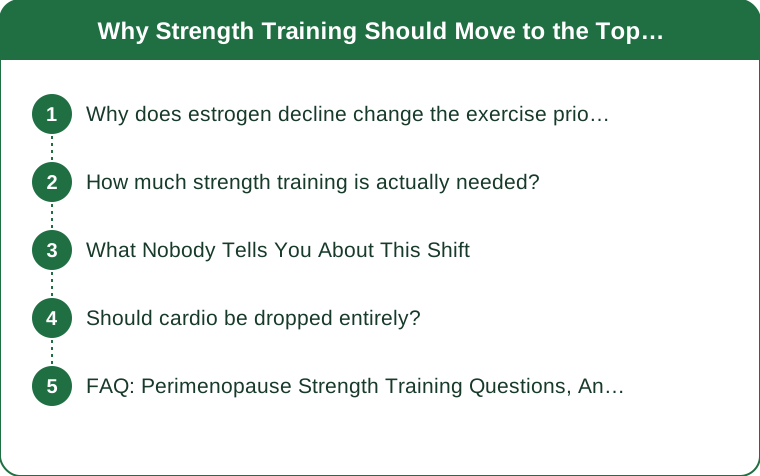
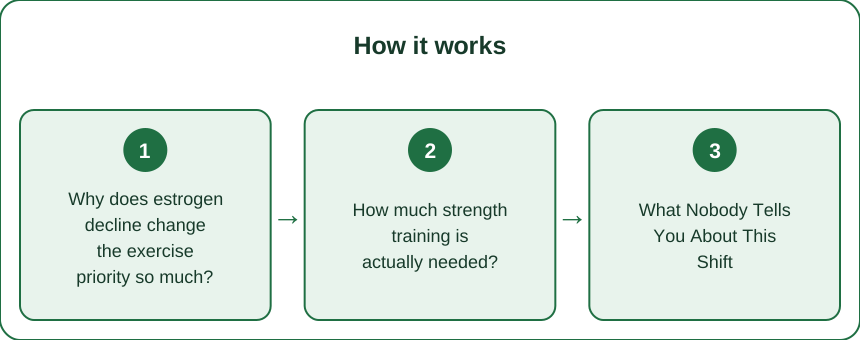
Why does estrogen decline change the exercise priority so much?
Estrogen plays a direct, protective role in both muscle protein synthesis and bone density maintenance. As it declines through perimenopause, both muscle mass and bone density can decline faster than in earlier decades — a pattern that cardio alone doesn’t meaningfully slow, since it doesn’t provide the mechanical loading stimulus muscle and bone need to maintain themselves.
This is why the fitness guidance shift toward strength training during this life stage isn’t a trend — it’s a direct response to a specific, well-documented physiological change.
How much strength training is actually needed?
2-3 sessions per week, focused on compound movements (squats, deadlifts, presses, rows) that load multiple large muscle groups, tends to be the range most commonly recommended for meaningfully slowing muscle and bone loss during this transition.
Progressive overload matters — gradually increasing weight or resistance over time is what drives the adaptation, not just repeating the same light routine indefinitely.

What Nobody Tells You About This Shift
Many women in perimenopause were raised on fitness messaging that prioritized cardio for weight management and avoided “bulky” strength training — messaging that’s now understood to be both outdated and counterproductive for this specific life stage. Building muscle doesn’t create bulk in the way that messaging implied; it directly supports the metabolic rate, bone density, and functional strength that become harder to maintain otherwise.
Also underrated: strength training supports better sleep and mood regulation during perimenopause, likely through its effects on stress hormone regulation — benefits that extend beyond the muscle and bone story.
Should cardio be dropped entirely?
No — cardiovascular health remains important, and moderate cardio supports heart health, which becomes more relevant post-menopause as estrogen’s cardioprotective effects also decline. The shift isn’t cardio-to-zero; it’s reprioritizing strength training to the top of the list and fitting cardio around it, rather than the reverse arrangement many women have followed for years.
A reasonable split for many: 2-3 strength sessions, 1-2 moderate cardio sessions per week, adjusted to individual energy and recovery.
FAQ: Perimenopause Strength Training Questions, Answered
Is it too late to start strength training in perimenopause?
No — muscle and bone respond to resistance training at any age, and starting now still meaningfully slows the trajectory of loss compared to not starting at all.
How soon do the benefits show up?
Strength gains often show within 4-6 weeks; bone density changes take considerably longer, typically 6-12 months of consistent training to measure meaningfully.
Do I need heavy weights, or does light resistance work too?
Progressive, challenging resistance (working near fatigue by the last few reps of a set) drives more adaptation than very light weights done for high reps indefinitely — the challenge level matters more than the absolute weight number.
TL;DR:
- Declining estrogen accelerates muscle and bone loss — strength training directly counters this
- 2-3 compound-movement sessions per week is the commonly recommended range
- Building muscle doesn’t mean bulk — outdated cardio-first messaging undersold this
- Cardio still matters for heart health, but strength training moves to top priority now
Keep Reading
This article is for general informational purposes only and is not medical advice. Always consult a qualified health professional for guidance specific to you.