Exercise in Perimenopause: Why Your Old Routine Stopped Working — and What Works Now
Quick Answer: In perimenopause, declining estrogen makes muscle harder to keep and stress harder to buffer — so the winning formula flips from ‘more cardio, eat less’ to lift heavy 2-3x a week, walk daily, sprint briefly 1-2x, and sleep like it’s your job. Punishing hour-long HIIT often backfires by stacking cortisol on an already-stressed system.
Somewhere in your 40s, the math quietly changes. The routine that maintained your weight for 15 years — the runs, the classes, the careful eating — starts returning smaller results, then none, then what feels like negative interest. It’s not your discipline. It’s estrogen, and the entire playbook it used to subsidize. The good news: the new playbook is arguably better, and it’s built on strength.

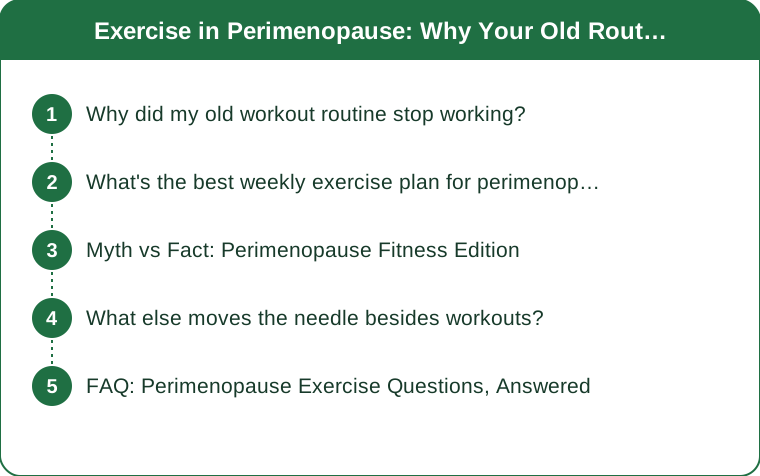
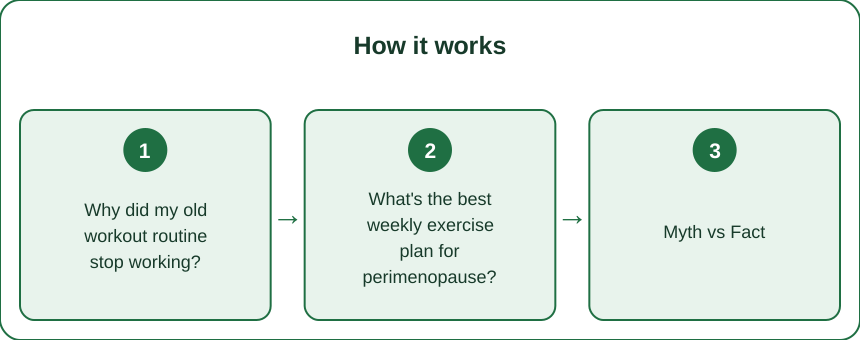
Why did my old workout routine stop working?
Estrogen was doing more than you knew. It supported muscle protein synthesis, insulin sensitivity, and recovery. As it declines and fluctuates through perimenopause (which starts on average around 40-44 and runs 4-8 years), three things shift: you lose muscle faster if you don’t actively fight for it — up to 3-8% per decade accelerating in your 40s — your body handles carbs less gracefully, and your stress response runs hotter.
That last one is the trap: long, punishing cardio sessions raise cortisol, and a perimenopausal system already leans cortisol-heavy. Many women find that adding more HIIT and longer runs during this stage coincides with more midsection weight, worse sleep, and flatter energy — the exact opposite of the deal they signed up for.
This is why the fix isn’t more of the old thing. It’s a different thing.
What’s the best weekly exercise plan for perimenopause?
The evidence-aligned template:
- Strength training 2-3x a week, actually heavy. Compound lifts (squat, hinge, press, pull) in the 6-12 rep range, where the last 2 reps feel like work. This is the single highest-leverage change — muscle is your metabolic engine, bone insurance, and glucose sponge.
- Daily walking, 7,000-10,000 steps. Low-cortisol movement that quietly handles calorie burn and blood-sugar control.
- Short, sharp intervals 1-2x a week — think 15-20 minutes of true sprints (bike, hill, rower: 20-30 seconds hard, full recovery). Brief intensity gives the metabolic signal without the cortisol marinade of hour-long HIIT.
- One real recovery practice: yoga, mobility, breathwork — because in this decade, recovery IS training.
What drops off the plan: daily long-distance cardio, back-to-back intense classes, and any workout that leaves you wired-but-exhausted at 11pm.
Myth vs Fact: Perimenopause Fitness Edition
Myth: Weight gain in your 40s means you need to eat less and do more cardio. Fact: The composition shift is driven by muscle loss and insulin changes. Aggressive restriction plus cardio accelerates the muscle loss — the exact wrong lever. Protein plus lifting is the right one.
Myth: Lifting heavy is dangerous in midlife. Fact: Progressive strength training is one of the best-evidenced interventions for midlife women — for bone density, metabolism, and mood. ‘Heavy’ means challenging for YOU, built up gradually with good form.
Myth: Light weights and high reps are safer for women. Fact: The 3-pound-dumbbell circuit doesn’t send a strong enough signal to keep muscle or bone. Safety comes from progression and form, not from staying weak.
Myth: It’s too late to start. Fact: Studies show women in their 40s, 50s, and beyond build meaningful muscle and bone within 6-12 months of starting. The best window was your 30s. The second-best window is this week.
What else moves the needle besides workouts?
Protein: 25-30g per meal, aiming for roughly 1.6-2.2g per kg of body weight daily. Muscle protein synthesis is less responsive now; you have to shout the signal.
Sleep is a training variable. Night sweats and 3am wake-ups sabotage recovery, appetite hormones, and next-day effort. Cool room (65-68°F), consistent wake time, and alcohol honesty — it fragments midlife sleep dramatically.
Track cycles while you still have them. Irregular is normal in peri; training slightly gentler in the late luteal week and harder in the follicular week works with the remaining rhythm.
And the professional line: perimenopause symptoms overlap with thyroid issues, iron deficiency, and more. Unexplained exhaustion, heavy bleeding, or mood changes that scare you deserve a doctor, not a harder workout plan. Hormone therapy is also a legitimate, evidence-supported conversation to have — the 2002-era fear narrative has been substantially revised.
FAQ: Perimenopause Exercise Questions, Answered
Can I still do HIIT in perimenopause?
Yes — shorter and sharper. 15-20 minutes of true intervals 1-2x a week captures the benefits. It’s the 45-60 minute daily beatdown classes that tend to backfire.
What exercise helps perimenopause belly fat most?
No exercise spot-reduces. The combination with the best evidence: heavy strength training (insulin sensitivity + muscle), daily walking (low-stress burn), protein at every meal, and sleep repair. Boring, effective, repeatable.
How fast will I see results from lifting?
Strength jumps in 4-6 weeks (that’s mostly your nervous system learning). Visible composition changes: 3-6 months. Bone density: 12+ months. This is a long game with compounding returns — the opposite of a 30-day challenge.
TL;DR:
- Estrogen’s exit changes the rules: muscle leaves faster, stress hits harder, old cardio math fails
- New formula: lift heavy 2-3x, walk daily, sprint briefly 1-2x, recover deliberately
- 25-30g protein per meal; treat sleep as training infrastructure
- Ditch the daily punishment cardio — it feeds the cortisol problem it’s trying to solve
- Persistent or scary symptoms → doctor first, not a harder program
Perimenopause isn’t the end of your athletic story. For a lot of women who pick up a barbell at 45, it’s chapter one of the strongest decade they’ve had.
Keep Reading
This article is for general informational purposes only and is not medical advice. Always consult a qualified health professional for guidance specific to you.